What Is Numerology — and Why Does It Matter?
By Kaalveda Research Team
In one paragraph
Numerology is the practice of reading meaning from numbers derived from your name and your date of birth. It is worth understanding one thing about it before anything else: numerology is deterministic. Give it the same two inputs and it returns the same numbers every time, on any device, computed by any practitioner, in any year. There is no sky to observe and no ephemeris to consult. The arithmetic is closed-form and takes seconds. That single property — that it is fully computable from what you already know about yourself — is why numerology spread across more cultures than almost any other symbolic system, and why it remains the easiest serious tradition for a beginner to enter.

What numerology actually is
Every numerological system rests on the same premise: that numbers are not merely quantities but qualities. One carries the character of initiation and singularity. Two carries partnership and duality. Nine carries completion. Assign numbers to the letters of a name and to the digits of a date, reduce them by fixed rules, and you obtain a small set of values that practitioners read as a description of temperament, motivation and timing.
The contrast with astrology is instructive, and it explains why the two are so often practised together.
Astrology is empirical. It requires real observational data — where the planets actually were at a specific moment, from a specific place on Earth. Get the birth time or the birthplace wrong and the chart is wrong. It needs an ephemeris, a timezone, coordinates.
Numerology is symbolic. It requires nothing but your name and your birth date. No time of day, no location, no astronomical data at all. This makes it dramatically more robust in practice — a very large number of people do not know their exact birth time, which cripples a serious astrological reading but leaves numerology entirely unaffected.
That robustness is the quiet reason numerology has such reach. It survives bad records.
The numbers that matter
Most of what any practitioner will tell you comes from five core values. Learn these and you can follow almost any numerology reading.
| Number | Computed from | What it describes |
|---|---|---|
| Life Path | Your full date of birth | The overall arc — the terrain you're walking. The single most important number. |
| Expression (Destiny) | All letters of your full birth name | Your natural abilities and how you operate in the world. |
| Soul Urge (Heart's Desire) | The vowels in your name | What actually motivates you, underneath the behaviour. |
| Personality | The consonants in your name | How others read you before they know you. |
| Birthday | The day of the month you were born | A specific gift or leaning that colours the Life Path. |
Two structural points are worth noticing. First, the Life Path comes from the date and cannot be changed — it is fixed at birth, like a Lagna. Second, the name-derived numbers can change, because names change: through marriage, through migration, through a deliberate change of spelling. This distinction is the entire basis of the name-correction practice that is so widespread in India, and it is why numerology is treated there as actionable in a way astrology mostly is not. You cannot change your birth chart. You can change how you spell your name.
Work one out
The Life Path is the number to learn first, and it takes about thirty seconds by hand. Reduce each component of the date to a single digit, then reduce the sum.
Take 15 August 1990.
- Day: 15 → 1 + 5 = 6
- Month: August = 08 → 8
- Year: 1990 → 1 + 9 + 9 + 0 = 19 → 1 + 9 = 10 → 1 + 0 = 1
Now sum those: 6 + 8 + 1 = 15 → 1 + 5 = 6.
That person's Life Path is 6 — conventionally read as the number of responsibility, care, family and service. Run the same date through any Pythagorean numerologist anywhere in the world and you will get 6. That reproducibility is not a small thing. It means disagreements between practitioners are almost always about interpretation, never about computation — which is the opposite of the situation in astrology, where practitioners routinely disagree about ayanamsha, house system and even which chart to read.
Four traditions, and why they disagree
There is no single numerology. There are four systems with serious followings, and they assign letters to numbers differently — which means the same name yields different values depending on which tradition you use.
Pythagorean (Greek, associated with the school of Pythagoras, c. 6th century BCE). Letters A–Z map to digits 1–9 in plain alphabetical order: A=1, B=2, … I=9, J=1, and so on. This is the Western default, and the overwhelming majority of English-language numerology writing assumes it.
Chaldean (Mesopotamian in origin, and considerably older). Letters map to 1–8 only. The digit 9 is held back as sacred and is never assigned to a letter, though it can appear in a total. The mappings follow the sound and vibration of the letter rather than alphabetical position, which makes the system less tidy but, its advocates argue, more faithful. Chaldean numerology is very widely used in India.
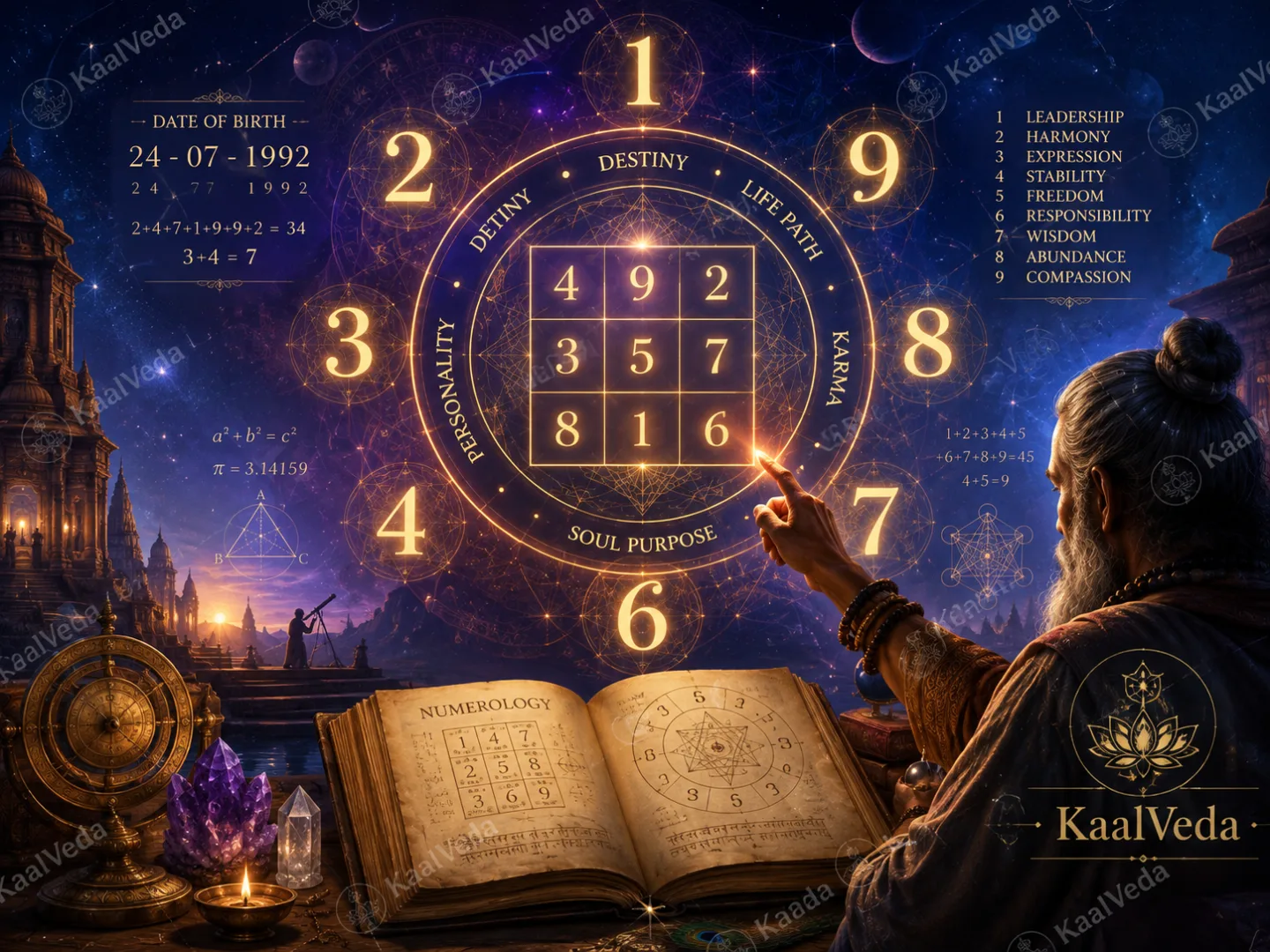
Lo Shu Grid (Chinese, with a long-established Vedic adaptation). A 3×3 magic square in which every row, column and diagonal sums to 15. Rather than producing a single number, it reads the digits of your birth date as occupancies — which cells are filled, which are empty, which repeat. It is a fundamentally different reading method: a map of presences and absences rather than a set of headline values.
Indian / Vedic numerology. Combines Chaldean letter-mapping with planetary correspondences — each digit 1 to 9 is assigned a graha (1 = Sun, 2 = Moon, 3 = Jupiter, 4 = Rahu, 5 = Mercury, 6 = Venus, 7 = Ketu, 8 = Saturn, 9 = Mars) — and brings in timing cycles. This is the version that interlocks with Jyotisha, and it is why an Indian practitioner will often read your numbers and your chart in the same sitting.
If you are new to this, the practical advice is simple: most working practitioners read by two or three systems at once and pay attention to where they agree. Convergence across systems is treated as signal; divergence is treated as nuance.
Master numbers and karmic debt
Two conventions interrupt the ordinary "reduce to a single digit" rule, and beginners trip over both.
Master numbers — 11, 22 and 33 — are generally not reduced. If your total lands on 11, you do not reduce it to 2; you read it as 11, understood as a higher-voltage, more demanding version of 2. Twenty-two is read as a master builder, thirty-three as a master teacher. The tradition's own framing is that master numbers describe greater potential and greater difficulty — they are not a compliment.
Karmic debt numbers — 13, 14, 16 and 19 — are read as carrying a specific corrective lesson when they appear as an intermediate total before reduction. In the worked example above, the year 1990 passed through 19 on its way to 1. Practitioners who work with karmic debt would note that.
Both conventions are modern-Western in their systematised form. Treat them as interpretive layers rather than ancient bedrock.
Why it matters
The honest case for numerology is not that it predicts events. It is that it produces a small, fixed, shared vocabulary for talking about a life — and that this turns out to be genuinely useful in four specific ways.
It makes decisions discussable. "Should I take this role?" is an unanswerable question in the abstract. "My Expression is 8 and my Soul Urge is 9, and this job is pure 8 with no 9 in it" is a question you can actually reason about. The numbers do not decide anything. They give you a frame precise enough to argue with.
It is actionable where astrology is not. Because the name-derived numbers respond to spelling, numerology supports a practice — adjusting a name, a business name, a brand, a signature — that has no astrological equivalent. Whether or not you accept the mechanism, the act of deliberately choosing how you are named is a real decision with real consequences for how you are received.
It works with incomplete data. No birth time, no birthplace, no problem. For a very large number of people this is the difference between a reading being possible and impossible.
It travels. Because the computation is language-independent arithmetic, numerology crosses cultures with far less distortion than most symbolic systems. The same Life Path calculation works identically in Hindi, Tamil or English.
In Indian practice specifically, numerology shows up in places Western readers may not expect: choosing a business name, selecting a mobile number, timing a launch, and above all name correction — adjusting the spelling of a personal name so its total resolves to a more favourable value. These are not fringe uses. They are, commercially, the main ones.
What numerology is not
An article that asks you to take something seriously owes you the limits.
Numerology is not predictive in the specific sense. Your Life Path does not tell you which day to buy a stock, whether a particular flight is safe, or what a medical test will show. Any practitioner claiming otherwise has left the tradition behind.
It is not a substitute for judgement — nor for medical advice, legal advice, or ordinary diligence.
And it is vulnerable to the Barnum effect: descriptions general enough to feel personal to almost anyone. "You have a great deal of unused capacity which you have not turned to your advantage" tests as accurate to most people who read it. A good practitioner works against this by being specific and falsifiable — by saying things you can actually disagree with. A weak one leans into it. The difference is easy to spot once you know to look.
The most defensible framing is the one experienced practitioners use themselves: numerology is a map. Maps do not drive the car. They tell you what is likely around the next bend, so you are not surprised by it.
How it sits alongside astrology
If you have read our piece on what astrology is and where it came from, the relationship should be clear.
Astrology reads a moment — the state of the sky when you arrived. Numerology reads a pattern — the structure encoded in your name and date. One is observational, the other symbolic. One needs precise time and place, the other needs neither.
Indian practice has never treated them as rivals. The same practitioner reads the kundli for the shape of the life and the numbers for the texture of the name, and treats agreement between them as worth noticing. The planetary correspondences in Vedic numerology exist precisely to let the two systems talk to each other: if your numbers are heavy in 8 and your chart is heavy in Saturn, that is the same statement made twice.
Where to start
Compute your Life Path by hand using the worked example above — it takes half a minute and it is the fastest way to understand what the system is actually doing.
After that, you can run your full numerology reading across all systems at once and see where they agree. If you are weighing a change of spelling, the name correction analysis shows what each variant totals to before you commit to anything. And if you want the version most often asked about in India, there is a dedicated mobile number analysis.
The arithmetic is the easy part. The reading is the craft — and like any craft, the way in is to start with your own numbers and see whether they describe anyone you recognise.
Was this article helpful?
Your feedback helps us improve our content
What Is a Daily Horoscope, and How Is It Actually Made?
Pyrite: The Stone, the Claims, and What Astrology Prescribes
Related Posts

How to Choose an Astrologer (and the Red Flags)
What a good reading actually looks like, the questions to ask before you book, and the red flags that mark a predatory practitioner - fear-selling, escalating remedies and guaranteed outcomes.

Karma, Free Will and Fate in Jyotisha
The birth chart is traditionally read as a map of prarabdha - the portion of karma already in motion - not of the whole. What Jyotisha actually says about fate, effort and the space between them.

What Are Divisional Charts (Vargas)?
A varga is a magnifying glass on one domain of life. What divisional charts are, why the navamsa carries so much weight, and the birth-time accuracy the finer ones genuinely demand.