What Is Janam Kundli or Janam Patri?
By Kaalveda Research Team
In one paragraph
A Janam Kundli — also called a Janam Patri, Janampatrika, jataka or simply a birth chart — is a diagram of the entire sky as it stood above your birthplace at the exact minute you were born. It is not a prediction, a score, or a personality label. It is a record: a frozen snapshot of where the nine grahas sat against the twelve signs, and where the horizon cut through them. Everything a Vedic astrologer does afterwards — reading your character, timing a marriage, judging a career, matching a couple — is interpretation layered on top of that one diagram. This article explains what goes into it, what the two chart formats mean, what each part of it does, and why the birth time matters more than almost anyone expects.
What the words mean
The vocabulary is less mysterious than it looks.
- Janam (जन्म) — birth
- Kundli (कुंडली) — literally a coil or ring, from the circular form of the diagram
- Patri / Patrika (पत्री / पत्रिका) — a leaf or document, from the palm-leaf manuscripts these were once written on
So Janam Kundli is "the birth diagram" and Janam Patri is "the birth document." In practice the two are used interchangeably, though Patri often implies the fuller written document — the chart plus its calculations, dashas and written interpretation — while Kundli often means the chart itself.
You will also meet jataka (the classical Sanskrit term for natal astrology), horoscope (the English word, covered in What Is a Horoscope — and What Are the Zodiac Signs?), and rashi chart or D-1, which specifically means the main chart as opposed to its divisional derivatives.
Three inputs, and why each one is non-negotiable

A kundli is computed, not chosen. These three values determine everything.
Date fixes which day's sky you are freezing.
Time fixes the rotation. This is the input people most often guess at, and it is the one that does the most damage when wrong. The Earth turns a full 360° every twenty-four hours, which means the zodiac rolls past the eastern horizon at roughly one degree every four minutes. Your Lagna — the rising sign — changes completely about every two hours.
Place fixes the horizon. The same instant produces a different Ascendant in Chennai than in Delhi, because latitude changes the angle at which the ecliptic crosses the horizon. Longitude also determines the true local time, which is not the same as clock time.
Here is the consequence, stated plainly:
Two babies born in the same hospital ninety minutes apart may share every planetary position — and still have completely different charts, because the entire house structure has rotated.
This is why a serious practitioner asks for your birth time before anything else, and why birth-time rectification is a specialist skill of its own. If your recorded time is a rounded "about 6 in the morning," treat the resulting chart's house placements as provisional.
You can generate a properly computed chart, with birthplace timezone and coordinates resolved correctly, using the **free Kundli generator**.
The two chart formats
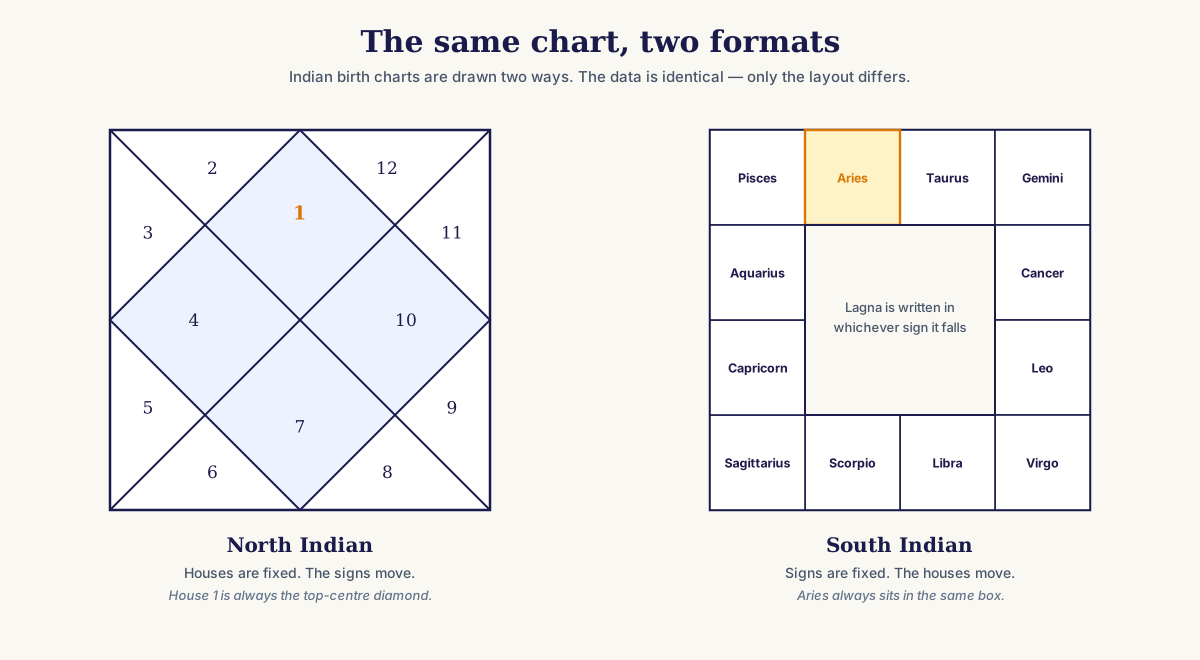
New readers are often thrown by the fact that the same kundli looks entirely different in North and South India. Both are correct. They encode identical data with opposite conventions.

The same chart in both conventions. Neither is more accurate — they simply fix different things in place.
North Indian (diamond format). The houses are fixed in the layout — house 1 is always the top-centre diamond, and the rest run anticlockwise. The signs move: a number is written into each house showing which sign occupies it. Read this format by house first.
South Indian (grid format). The signs are fixed — Aries always occupies the same box, and the twelve signs run clockwise around a four-by-four grid with a blank centre. The houses move: the Lagna is marked in whichever sign it falls, and you count houses onward from there. Read this format by sign first.
There is also an East Indian (Bengali) format, a square variant, common in Bengal, Odisha and Assam.
The practical advice: learn to read one properly rather than both badly. Most modern software — including ours — can render either.
What is actually inside a kundli
A complete chart carries several layers. In rough order of how a practitioner uses them:
The Lagna (Ascendant). The degree of the zodiac rising in the east. This is the foundation. It sets the numbering of all twelve houses, and it describes the body, constitution and overall direction of the life. In Jyotisha the Lagna outranks the Sun sign.
The nine grahas. Sun (Surya), Moon (Chandra), Mars (Mangal), Mercury (Budh), Jupiter (Guru), Venus (Shukra), Saturn (Shani), plus the two lunar nodes Rahu and Ketu. Note there is no Uranus, Neptune or Pluto — the classical system uses only what is visible to the eye, plus the nodes.
The twelve bhavas (houses). Domains of life: self, wealth, courage, home, children, obstacles, marriage, longevity, fortune, career, gains, loss. Each is ruled by the sign upon it, and by that sign's ruling graha.
The nakshatra. Which of the 27 lunar mansions the Moon occupied. Your janma nakshatra is the basis of the dasha system and, traditionally, of your naming ceremony. There is more on this in What Is Nakshatra and Choghadiya — and How Are They Used?.
The divisional charts (vargas). The main chart, D-1, is subdivided into finer charts for specific domains — most importantly the navamsa (D-9) for marriage and inner strength, the dashamsha (D-10) for career, and the drekkana (D-3) for siblings. A reading that ignores the D-9 is incomplete.
The dashas. The Vimshottari dasha system divides life into planetary periods, computed from your janma nakshatra. This is what lets Jyotisha speak about timing rather than only tendency.
How a kundli is read
Reading is a sequence of judgements, not a lookup table:
- Establish the Lagna and assess its ruling graha — strong or weak, well-placed or afflicted.
- Judge each graha's dignity — is it exalted (uccha), debilitated (neecha), in its own sign (swakshetra), or combust?
- Map the placements — which graha sits in which house, and which houses does each one rule?
- Identify the yogas — named planetary combinations with specific effects, such as the pancha-mahapurusha yogas.
- Check the divisional charts — does the D-9 confirm or contradict the D-1?
- Run the dashas — which planetary period is active now, and what does it activate?
- Overlay transits (gochara) — where are the planets today relative to the birth chart?
Steps 6 and 7 are where prediction actually happens. Steps 1 to 5 describe the potential; the dasha decides when it ripens.
Kundli matching for marriage
The most common practical use of a kundli in India is matching — Kundli Milan or Gun Milan.
The standard method is Ashtakoota Milan: eight factors (kutas) scored to a maximum of 36 points. What most people do not realise is that six of the eight kutas are computed from the nakshatra, not the sign — which makes the matching system far more Indian in structure than the twelve-sign zodiac it sits beside.
| Kuta | Points | Judges |
|---|---|---|
| Varna | 1 | Temperament and work orientation |
| Vashya | 2 | Mutual influence |
| Tara | 3 | Health and fortune |
| Yoni | 4 | Physical and instinctive compatibility |
| Graha Maitri | 5 | Mental affinity |
| Gana | 6 | Nature and disposition |
| Bhakoot | 7 | Emotional and material welfare |
| Nadi | 8 | Health and progeny |
An honest caveat that reputable practitioners state and many websites do not: the 36-point scoring system is early-modern, not Vedic. It was systematised in muhurta literature around the sixteenth and seventeenth centuries. The vocabulary it scores in — the nakshatras — is genuinely ancient. The scorecard is not.
Use it as one input among several. A score is not a verdict on a marriage. You can run one with the **free Gun Milan calculator**.
Common misconceptions
"A kundli predicts my future." It describes structure and timing. Classical texts are consistent that the chart shows tendency, and that effort (purushartha) and judgement operate within it.
"A bad chart means a bad life." There is no such thing as a bad chart. Every chart has strong and weak areas; the useful question is which is which, and when each becomes active.
"I don't know my birth time, so I can't have a kundli." You can still get an accurate Moon sign, nakshatra and planetary positions — those move slowly. Only the Lagna and the house structure become unreliable. Say so honestly to whoever reads it.
"Manglik dosha will ruin my marriage." Manglik rules vary substantially between North and South Indian traditions, and the doctrine is late-medieval rather than Vedic. Treat any practitioner who presents it as an unarguable verdict with caution.
"All kundli software gives the same answer." It does not. Results depend on the ayanamsha used, the house system, and whether the software correctly resolves your birthplace's historical timezone. Two apps can legitimately differ by a degree or more.
Where to start
The fastest way to understand your own chart is to generate it and sit with it.
- Compute your core placements with the **Lagna, Rashi & Nakshatra calculator**
- Generate a complete **free Janam Kundli** — all twelve houses, nine grahas, nakshatras and divisional charts
- For marriage matching, run **Gun Milan**
- For a full written interpretation across every chapter, there is the **premium Kundli report**
- Browse the rest of the **free calculators**
And for the background rather than the mechanics, read **What Is Astrology — and Who Gave It to the World?**, or the companion piece on **horoscopes and zodiac signs**.
Start with your Lagna. Every other judgement in the chart is built on top of it.
Was this article helpful?
Your feedback helps us improve our content
The Seven Horses Painting: Meaning, Vastu Placement and Origin
Horoscope Astrology by Date of Birth: Generate Your Chart Free
Related Posts

Gajakesari Yoga and Other Wealth Yogas
Gajakesari yoga means Jupiter in a kendra from the Moon - a configuration present in roughly one chart in three. Here is what it really signifies, how the genuine dhana yogas work, and why wealth yogas so often fail to deliver.

Pancha Mahapurusha Yogas Explained
One of five grahas in its own sign or exaltation, and simultaneously in a kendra from the Lagna. That is the whole rule. Here are the five yogas, what weakens them, and the arithmetic showing roughly one chart in three carries at least one.

Raja Yogas: The Combinations for Success
Raja yogas are the named combinations that classical Jyotisha links to status and success. Most charts contain several. This guide explains the real definition, the main types, and the strict conditions under which one actually delivers.