What Is Nakshatra and Choghadiya — and How Are They Used?
By Kaalveda Research Team
In one paragraph
Nakshatra and Choghadiya answer two different questions that Indian tradition treats as equally practical. A nakshatra is where — one of 27 segments of the sky, each 13°20′ wide, that the Moon moves through roughly one per day. A choghadiya is when — one of eight slots that divide today's daylight, each carrying a quality from Amrit (excellent) to Kaal (avoid). The first is the oldest layer of Indian astronomy and drives the entire timing system of a birth chart. The second is a folk-practical tool people genuinely use before signing a document or starting a journey. This article covers both properly, and shows how they fit together.
Part One: Nakshatra
The 27 lunar mansions
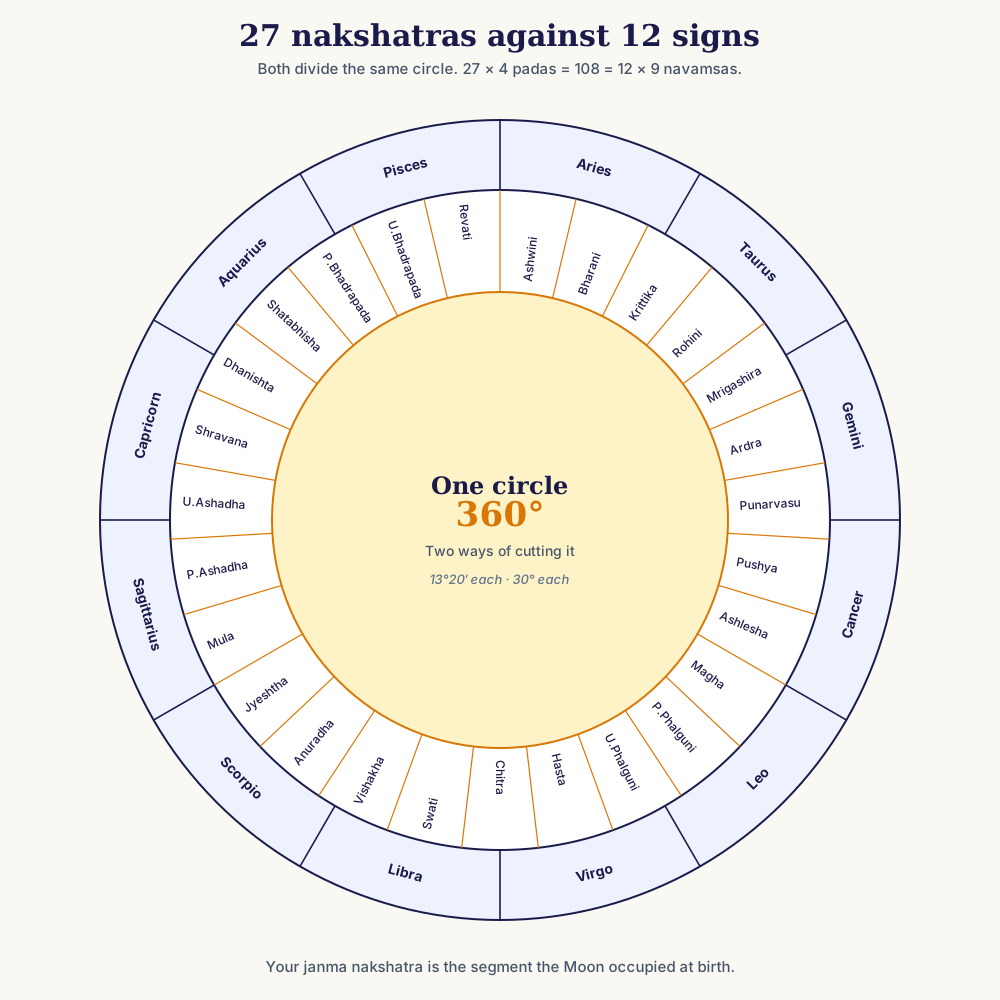
The Moon completes a circuit of the zodiac in about 27.3 days. Divide that circle into 27 equal parts and each part is a nakshatra — 13°20′ of arc, or roughly one day of lunar travel.

The same 360° circle, cut two ways. This is the structural relationship that makes Indian astrology what it is.
Look carefully at that diagram, because it contains the most important structural fact in Jyotisha:
27 nakshatras × 4 padas = 108 = 12 signs × 9 navamsas.
The navamsa boundaries coincide exactly with the nakshatra quarters.
That is not a coincidence. The D-9 chart — the divisional chart Indian astrologers rely on most heavily for marriage and inner strength — is the indigenous nakshatra system re-expressed in the imported twelve-sign zodiac. As covered in our history of astrology, the nakshatras are attested in the Vedic corpus centuries before the twelve-sign zodiac reached India. When the zodiac arrived, India did not replace its older system — it welded the two together.
Where the nakshatras came from
The nakshatras are the oldest continuously used astronomical framework in India.
The complete list of twenty-seven appears in the Taittiriya Samhita; a twenty-eight-fold list including Abhijit appears in the Atharvaveda. Individual names appear earlier still. The system is calendrical and ritual in origin — it existed to time sacrifices, not to profile personalities.
The point worth stating carefully, because it is often overstated in both directions: there is no Mesopotamian prototype for a 27-fold division of the ecliptic. The nearest Babylonian analogue lists seventeen or eighteen uneven constellations along the Moon's path — a structurally different object. Mainstream historians of Indian mathematics take the nakshatra system to be an independent Indian development. That is a strong, defensible claim, and it does not require inflating anything.
What a nakshatra carries
Each nakshatra has a cluster of attributes that a practitioner reads together:
| Attribute | What it means |
|---|---|
| Ruling graha | Sets the Vimshottari dasha sequence |
| Deity | The presiding force — e.g. Ashwini's Ashwini Kumaras, the divine physicians |
| Symbol | A compressed image of its nature — a horse's head, a bow, a lotus |
| Gana | Deva (divine), Manushya (human) or Rakshasa (fierce) — used in matching |
| Yoni | An animal symbol, used for compatibility |
| Nadi | Adi, Madhya or Antya — the highest-weighted factor in Gun Milan |
| Pada | Four quarters, each mapping to a navamsa sign |
The first few, to make it concrete: Ashwini (ruled by Ketu, symbol a horse's head, associated with speed and healing), Bharani (Venus, the yoni, associated with bearing and transformation), Krittika (Sun, a blade, associated with cutting through and purification), Rohini (Moon, a cart, associated with growth and beauty — traditionally the Moon's favourite).
You can read all twenty-seven in detail in our **nakshatra guide**, starting with Ashwini.
Why the janma nakshatra matters so much
Your janma nakshatra is the one the Moon occupied at your birth. It does more work in Jyotisha than any other single factor except the Lagna:
It drives the dasha system. Vimshottari dasha — the 120-year cycle of planetary periods that lets Indian astrology speak about timing — is calculated directly from the exact degree of the Moon within your janma nakshatra. Change the nakshatra and you change the entire timeline of the life.
It sets the naming syllable. Traditionally the first syllable of a child's name is chosen from the pada of the janma nakshatra.
It carries most of marriage matching. In Ashtakoota Gun Milan, six of the eight kutas — Tara, Yoni, Gana, Bhakoot, Nadi and part of Varna — are computed from the nakshatra rather than the sign. Run one on the **Gun Milan calculator** and you are mostly comparing nakshatras.
It anchors daily prediction. Tara bala, the strength of the day relative to your birth star, is read from the count between today's nakshatra and yours.
Find yours with the **Lagna, Rashi & Nakshatra calculator**.
Part Two: Choghadiya
Eight slots, sunrise to sunset
Choghadiya (चौघड़िया) comes from cho (four) + ghadi (a traditional time unit of about 24 minutes) — so roughly four ghadis, about 96 minutes, per slot.

The Sunday sequence. The order rotates by weekday, and night has its own eight slots.
The daylight period is divided into eight equal parts, and each carries a name and a quality:
| Choghadiya | Ruler | Quality | Traditionally used for |
|---|---|---|---|
| Amrit | Moon | Excellent | Anything — the best slot of the day |
| Shubh | Jupiter | Good | Marriage, ceremonies, auspicious beginnings |
| Labh | Mercury | Good | Business, trade, education, new ventures |
| Char | Venus | Neutral | Travel and movement |
| Udveg | Sun | Avoid | Government work only |
| Rog | Mars | Avoid | Nothing; associated with conflict and illness |
| Kaal | Saturn | Avoid | Nothing auspicious; wealth accumulation by some traditions |
Two details that most summaries get wrong:
The slots are not 90 minutes. They are one-eighth of the actual daylight at your location, so they stretch in summer and compress in winter. In Delhi in June a day slot runs well over 100 minutes; in December, well under 80. Any tool quoting a fixed duration is approximating.
The sequence rotates by weekday. Sunday begins with Udveg, Monday with Amrit, Tuesday with Rog, and so on. This is why you cannot memorise one order and reuse it.
There is also a night Choghadiya, dividing sunset to sunrise into its own eight slots in a different sequence.
How Choghadiya is actually used
Choghadiya is the most everyday of all these tools — closer to folk practice than to classical Jyotisha, and used casually by people who would never commission a chart reading.
Typical uses: starting a journey (Char is favoured), opening a shop or signing a deal (Labh), beginning a ceremony (Shubh or Amrit), and avoiding the Rog, Kaal and Udveg windows for anything new.
A word of proportion, honestly stated: Choghadiya is a coarse instrument. It uses only the weekday and the sunrise/sunset times — no planetary positions, no tithi, no nakshatra. For a genuinely important decision — a wedding date, a business incorporation — a proper muhurat analysis using the full Panchang is the appropriate tool, not an eightfold day-split. Choghadiya is for the everyday question of "should I start this now or after lunch?"
Check the live slots on the **Choghadiya calculator**.
How the two fit together
Nakshatra and Choghadiya sit at opposite ends of the same tradition.
| Nakshatra | Choghadiya | |
|---|---|---|
| Answers | Where the Moon is | What quality this hour has |
| Resolution | ~1 day | ~90 minutes |
| Basis | Actual lunar longitude | Weekday + sunrise/sunset |
| Depth | Classical, Vedic-era | Folk-practical, later |
| Used for | Dashas, matching, naming, prediction | Everyday timing decisions |
Both are limbs of the same almanac. The nakshatra is one of the five angas of the Panchang; the Choghadiya is one of its derived timing tables. A full muhurat calculation uses the nakshatra and the tithi and the weekday and avoids Rahu Kaal — the Choghadiya is the quick approximation of that fuller judgement.
Where to start
- Find your janma nakshatra with the **Lagna, Rashi & Nakshatra calculator**
- Read all 27 in the **nakshatra guide**
- Check the live **Choghadiya** for today's slots
- See the full **Panchang**, including Rahu Kaal and Abhijit Muhurat
- Run **Gun Milan** to see the nakshatra doing the work in marriage matching
- Generate a **free Janam Kundli** with your nakshatra and dasha timeline
Related reading: **What Is Panchang and the Panchang Calendar?** · **What Is Janam Kundli or Janam Patri?** · **What Is a Horoscope and What Are the Zodiac Signs?**
If you learn only one thing from this article, make it the 108. Twenty-seven nakshatras, four quarters each, twelve signs, nine navamsas — one circle, cut two ways, locked together. That structure is Indian astrology.
Was this article helpful?
Your feedback helps us improve our content
What Is Panchang and the Panchang Calendar?
What Are the Occult Sciences, and What Falls Under Them?
Related Posts

Tithi Explained: The Thirty Lunar Days
A tithi is the time the Moon needs to gain 12 degrees on the Sun, which is why it is never exactly 24 hours. Here is why Hindu dates skip and repeat, all thirty tithis, and the five tithi groups.

Griha Pravesh Muhurat: Timing a House Warming
Vedic tradition names three kinds of house entry, each with its own rules. This guide covers the tithi, nakshatra, weekday and lagna a griha pravesh muhurat is chosen on, the months avoided, and how to handle a possession date that will not move.

How to Choose a Wedding Muhurat
A step-by-step method for choosing a vivah muhurat - tithi, nakshatra, weekday, yoga, karana and lagna - plus the months ruled out entirely and why the Indian wedding season falls where it does.