What Are the Occult Sciences, and What Falls Under Them?
By Kaalveda Research Team
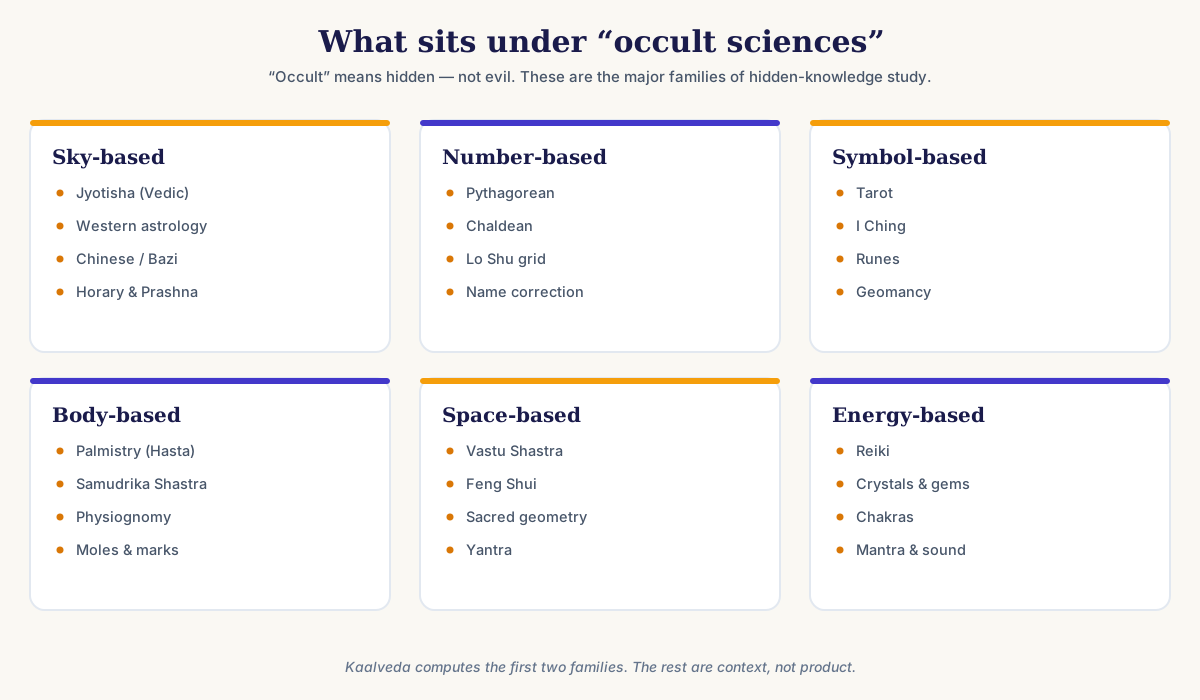
In one paragraph
Occult comes from the Latin occultus — "hidden" or "covered over." It is the same root that gives astronomy the word occultation, when one body passes in front of another. It does not mean evil, satanic, or forbidden, whatever popular culture has done to the word. The occult sciences are the body of disciplines that claim to read hidden correspondences — patterns connecting the sky, numbers, symbols, space and the body to human life. In India this territory is largely covered by Jyotisha and its neighbouring shastras; in the West it accumulated under names like Hermeticism and the esoteric tradition. This article maps the major families, explains what each actually studies, and is honest about which of them have evidence behind them and which are traditions of practice rather than findings.
What "occult" actually means
Three distinctions clear up most of the confusion.
Occult ≠ evil. The word only ever meant hidden knowledge — things not apparent to ordinary observation. For most of history the term carried no moral charge at all. Kepler, Newton and half the founders of modern science worked in fields we would now file under occult.
Occult ≠ religion. Religion concerns worship, devotion and salvation. The occult sciences concern technique — methods for reading or influencing hidden correspondences. Plenty of practitioners are devout; plenty are not; the two are separate categories.
Occult ≠ pseudoscience, necessarily. Some of these disciplines make testable claims and have been tested. Others make no empirical claim at all and are better understood as symbolic or interpretive systems. Collapsing them into one bucket — in either direction — is the commonest mistake.
The umbrella Indian term is gupt vidya (गुप्त विद्या), "hidden knowledge," and it sits alongside para vidya (higher knowledge) and apara vidya (applied knowledge, which is where the Vedangas including Jyotisha are classified).
The six families

Grouped by what each one actually reads: the sky, numbers, symbols, the body, space, or energy.
Sky-based — astrology
The largest and best-documented family. Jyotisha is the Indian branch, one of the six Vedangas and traditionally called the eye of the Veda — because it is the faculty by which the correct ritual time is seen. Its three limbs are ganita (computation), hora (horoscopy) and samhita (mundane and collective prediction).
Alongside it sit Western astrology (tropical zodiac, Hellenistic in structure), Chinese astrology including Bazi or Four Pillars, and question-based branches: Prashna in India, horary in the West, where a chart is cast for the moment a question is asked rather than for a birth.
Full background in **What Is Astrology — and Who Gave It to the World?**. Try the **Bazi calculator** or generate a **Janam Kundli**.
Number-based — numerology
Meaning read from numbers derived from name and birth date. The main traditions are Pythagorean (letters map to 1–9 alphabetically), Chaldean (letters map to 1–8, with 9 held sacred), the Lo Shu grid (a 3×3 magic square reading digit occupancies), and Indian Vedic numerology, which fuses Chaldean mapping with planetary correspondences.
Numerology's distinguishing property is that it is deterministic and needs no birth time — which is why it works where astrology cannot. See **What Is Numerology — and Why Does It Matter?**, or run a **numerology reading** or **name correction analysis**.
Symbol-based — divination
Systems that read meaning from a randomised symbolic draw: Tarot (78 cards, European, 15th century as a card game and 18th century as divination), the I Ching (Chinese, 64 hexagrams, genuinely ancient), runes (Germanic), and geomancy (figures generated from marks in earth or on paper).
These differ from astrology in a fundamental way: astrology reads a fixed, computable state of the sky, while divination reads a randomised draw interpreted as meaningful. Practitioners frame this through synchronicity — meaningful coincidence — rather than causation. Explore the **tarot section**.
Body-based — reading the person
Palmistry (Hasta Samudrika) reads the hands. Samudrika Shastra is the broader Indian science of body-reading, covering face, feet, marks and moles. Physiognomy is the Western equivalent.
An honest note that belongs here: physiognomy has a genuinely ugly history — it was used in the nineteenth and twentieth centuries to underpin racial pseudoscience, and modern attempts to revive facial inference through machine learning have attracted the same criticism for the same reasons. The traditional Indian practice is a different thing with different aims, but the caution is worth carrying. See our **palmistry section**.
Space-based — arranging the environment
Vastu Shastra is the Indian science of architecture and orientation, with roots in the Sthapatya Veda and a substantial classical literature covering site selection, proportion, orientation and the Vastu Purusha Mandala. Feng Shui is the Chinese counterpart, organised around qi flow, the bagua and the five elements. Yantra and sacred geometry apply the same logic at the scale of a diagram rather than a building.
What is defensible about this family without any metaphysics: much of it encodes sound environmental design for its climate — orientation for light and prevailing wind, ventilation, water placement, thermal mass. Whether the metaphysical layer adds anything beyond that is exactly where the disagreement lives. Explore **Feng Shui**.
Energy-based — subtle body and vibration
Reiki, crystal and gemstone therapy, the chakra system, and mantra or sound practice. In Indian tradition, gemstone prescription (ratna) is tightly coupled to Jyotisha — a stone is recommended to strengthen a specific weak graha in a specific chart, not chosen by preference.
This family makes the most direct physical claims of the six, and is correspondingly the one where controlled trials have been least kind. Where it demonstrably helps — relaxation, ritual structure, the felt sense of having done something — those are real effects with well-understood mechanisms.
What is evidence, and what is tradition
An article claiming authority has to draw this line rather than blur it.
Genuine science that grew out of this territory. Astrology drove the development of observational astronomy for two thousand years — the ephemerides, the coordinate systems, the predictive mathematics. Alchemy became chemistry. These are not embarrassments in the ancestry of science; they are the ancestry.
Testable claims that have been tested. Astrology's predictive claims have been examined in controlled studies, and the results are broadly negative — chart-matching trials cluster near zero correlation, and a well-designed study of over two thousand people born in London within the same week found no convergence across more than a hundred variables. That is the honest state of the evidence, and we said so plainly in our history of astrology.
Claims that were never empirical. Much of this field does not make the kind of claim a trial can address. When a practitioner says a chart describes a tendency, or that a tarot spread structures reflection on a decision, that is an interpretive claim, not a mechanical one. It should be judged as one — by whether it is coherent, useful and honestly delivered — not by a p-value it was never making.
Where genuine harm happens. Not in the symbolism, but in the application: astrological or numerological grounds used to block a marriage; expensive gemstones sold as a cure for a medical condition; ritual remedies (upaya) sold at escalating prices to a frightened client; any practitioner who substitutes a reading for a doctor. These are real problems and they deserve to be named. A reputable practitioner refers out, quotes a fixed price, and never presents a reading as a verdict.
How Kaalveda thinks about this
We compute two of the six families — sky-based and number-based — because those are the two that are computable. A kundli, a Panchang, a dasha timeline, a Life Path number: these are deterministic outputs of well-defined arithmetic, and getting the arithmetic right is a real engineering problem worth solving properly.
The rest we treat as context, not product. We will explain what tarot or Vastu or palmistry is, because readers ask; we do not claim to have computed anything about your life from them.
And we take the honest position on all of it: a chart is a map, not a verdict. It describes terrain. It does not decide where you walk, and anyone telling you otherwise is selling something.
Where to start
- Generate a **free Janam Kundli** — the computable core of the sky-based family
- Find your **Lagna, Rashi and Nakshatra**
- Run a **numerology reading** or a **name correction analysis**
- Try the **Bazi / Four Pillars calculator** for the Chinese branch
- Explore **tarot**, **palmistry** and **Feng Shui**
- Check **today's Panchang** and browse all **free calculators**
Related reading: **What Is Astrology — and Who Gave It to the World?** · **What Is Numerology — and Why Does It Matter?** · **What Is Janam Kundli or Janam Patri?** · **What Is Panchang and the Panchang Calendar?**
The word only ever meant hidden. What is worth arguing about is not the label but the standard of evidence each discipline is willing to be held to — and whether the person in front of you is honest about which kind of claim they are making.
Was this article helpful?
Your feedback helps us improve our content
What Is Nakshatra and Choghadiya — and How Are They Used?
How Kundli Matching / Gun Milan Works
Related Posts

How to Choose an Astrologer (and the Red Flags)
What a good reading actually looks like, the questions to ask before you book, and the red flags that mark a predatory practitioner - fear-selling, escalating remedies and guaranteed outcomes.

Karma, Free Will and Fate in Jyotisha
The birth chart is traditionally read as a map of prarabdha - the portion of karma already in motion - not of the whole. What Jyotisha actually says about fate, effort and the space between them.

What Are Divisional Charts (Vargas)?
A varga is a magnifying glass on one domain of life. What divisional charts are, why the navamsa carries so much weight, and the birth-time accuracy the finer ones genuinely demand.