How Kundli Matching / Gun Milan Works
By Kaalveda Research Team
In one paragraph
Kundli Matching — Kundli Milan, or Gun Milan — is the process of comparing two birth charts before a marriage. The dominant method across most of India is Ashtakoota Milan: eight factors, called kutas, scored out of a combined 36 points. What almost nobody is told is the most interesting fact about it: six of the eight kutas are computed from the nakshatra, not the zodiac sign — which makes the system structurally far more Indian than the twelve-sign zodiac sitting beside it. This article walks through all eight, explains what a score actually means, covers the doshas that override the score entirely, and is honest about the parts of the tradition that are ancient and the parts that are not.
What is being compared
Matching does not compare two people. It compares two Moons.
Specifically, Ashtakoota Milan works almost entirely from each person's janma nakshatra — the lunar mansion the Moon occupied at birth — and each person's Moon sign (Chandra Rashi). The Sun sign plays no part. The Lagna plays no direct part in the eight kutas at all.
That has a practical consequence worth knowing before you start: matching needs only date, time and place accurate enough to fix the Moon's nakshatra, which the Moon holds for about a day. It is therefore more forgiving of an uncertain birth time than a full Janam Kundli reading, where a two-hour error changes the entire house structure.
The eight kutas

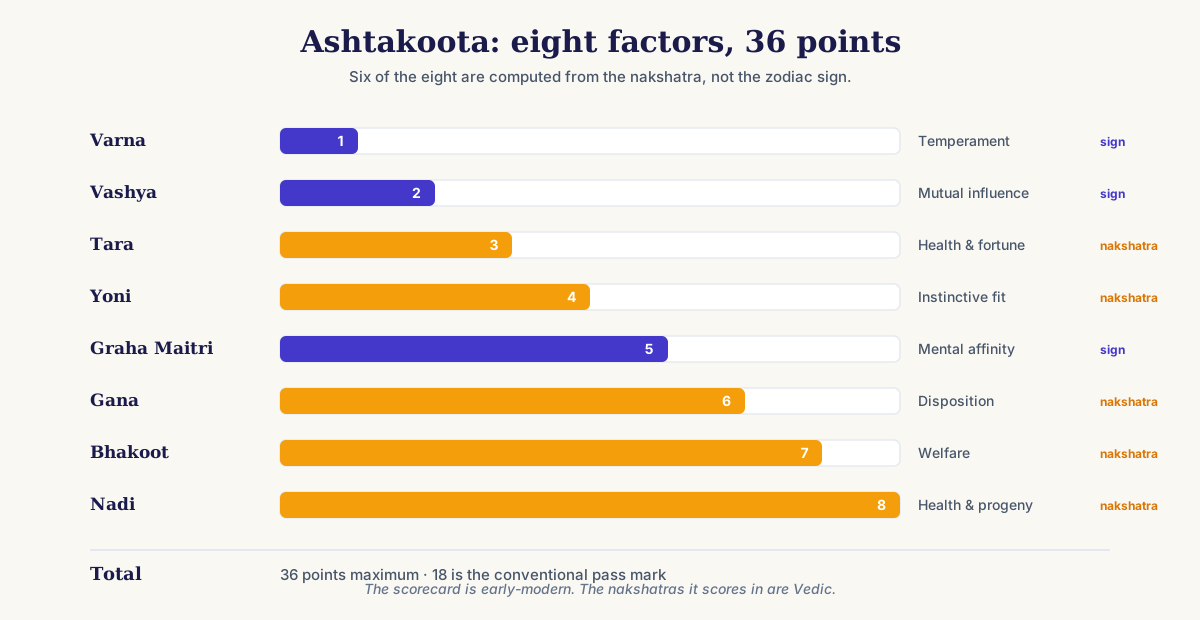
Eight factors, 36 points. The saffron bars are computed from the nakshatra; the indigo bars from the sign.
1. Varna — 1 point. Temperament and work orientation, in four grades (Brahmin, Kshatriya, Vaishya, Shudra) derived from the Moon sign. It scores when the groom's varna is equal to or higher than the bride's. This is the most socially loaded kuta and carries the fewest points — which tells you something about how the tradition itself weighted it.
2. Vashya — 2 points. Mutual influence and magnetism — who naturally holds sway. Derived from the Moon sign, grouped into categories such as quadruped, human, water-dwelling and wild.
3. Tara — 3 points. Health, fortune and longevity, computed by counting nakshatras from one partner's birth star to the other's, in both directions, and testing the remainders. Certain counts are inauspicious.
4. Yoni — 4 points. Physical and instinctive compatibility. Each nakshatra is assigned an animal — horse, elephant, sheep, serpent, dog, cat, rat, cow, buffalo, tiger, deer, monkey, mongoose, lion. Compatibility is judged by whether the two animals are friendly, neutral or naturally hostile. Same animal scores full marks; a predator–prey pair scores zero.
5. Graha Maitri — 5 points. Mental affinity and friendship, judged by whether the lords of the two Moon signs are natural friends, neutral, or enemies. This is the one kuta that reasons about planets rather than stars.
6. Gana — 6 points. Disposition. Each nakshatra belongs to one of three ganas: Deva (divine — gentle, principled), Manushya (human — mixed, practical) or Rakshasa (fierce — intense, wilful). Deva–Deva and Manushya–Manushya score full; Deva–Rakshasa scores zero.
7. Bhakoot — 7 points. Emotional and material welfare, judged by the distance between the two Moon signs. Certain relative positions — 6/8, 9/5 and 2/12 — score zero and constitute Bhakoot dosha. This is one of the two heavyweight kutas.
8. Nadi — 8 points. The highest-weighted factor, concerning health, genetics and progeny. Each nakshatra falls into one of three nadis: Adi, Madhya or Antya. If both partners share the same nadi, the result is Nadi dosha and the kuta scores zero out of eight — which alone can drag a match below the pass mark.
What a score actually means
| Score | Conventional reading |
|---|---|
| Below 18 | Not recommended without remedial consideration |
| 18 – 24 | Acceptable; the common threshold for proceeding |
| 25 – 32 | Very good |
| 33 – 36 | Exceptional, and genuinely rare |
18 out of 36 is the usual pass mark. But the number on its own is a poor summary, for three reasons.
First, the composition matters more than the total. A 20 built on strong Nadi and Bhakoot is a materially better match than a 20 that scraped through on the small kutas while failing both heavyweights. Ask which points were lost, not just how many.
Second, a high score is not a prediction of happiness. It indicates traditional compatibility on eight specific axes. It says nothing about shared values, finances, family dynamics or whether two people actually like each other.
Third, Ashtakoota is not the only system. In much of South India, matching runs on Dashakoota — ten factors — and the scoring differs. A couple can score differently under the two systems, and neither is "wrong."
Run your own with the **free Gun Milan calculator**.
The doshas that override the score
A good total does not clear a match on its own. Practitioners check several conditions that are treated as overriding.
Nadi dosha. Same nadi for both partners. Traditionally the most serious, associated with health and progeny concerns. Widely held to be cancelled if the couple share a Moon sign but different nakshatras, or share a nakshatra but different padas — among other exceptions.
Bhakoot dosha. The 6/8, 9/5 or 2/12 Moon-sign relationship. Cancelled in several cases, including when the sign lords are friends or identical.
Mangal dosha. Mars in certain houses. Substantial enough to have its own article — see **What Is Mangal Dosh or Manglik?**.
Longevity and 7th-house condition. A careful astrologer looks past the eight kutas at each chart individually: the 7th house and its lord, Venus in a man's chart, Jupiter in a woman's, and the condition of the 2nd and 8th houses. A perfect 36 with a badly afflicted 7th house is not a good match, and no scorecard will tell you that.
This last point is the one that separates a real reading from a website score. Ashtakoota is a screening tool, not a verdict.
Where the system actually comes from
Being straight about this makes the tradition more credible, not less.
The nakshatras are genuinely ancient. The full list of twenty-seven appears in the Vedic corpus, centuries before the twelve-sign zodiac reached India — and there is no foreign prototype for a 27-fold division of the ecliptic. That layer is indigenous, old, and the substance of what Gun Milan actually measures. Background in our history of astrology.
The 36-point scorecard is not. The Ashtakoota system in the form used today — eight named kutas, these specific weights, this total — was systematised in muhurta literature of the sixteenth and seventeenth centuries, notably the Muhurta Chintamani. That is early-modern, not Vedic.
So the honest formulation is: the vocabulary is Vedic; the scorecard is roughly four hundred years old. Anyone presenting the 36 points as an unbroken Vedic revelation is overclaiming, and anyone dismissing the whole thing because the scorecard is late is throwing out the genuinely ancient part with it.
How to use it well
A few things worth saying plainly, because this is where matching does real damage in people's lives.
Do not treat a score as a veto. It is one input among many. Families that break off a compatible engagement over a 16 are acting on a number whose scoring conventions are four centuries old and regionally variable.
Get both charts computed properly. Results depend on the ayanamsha and on correct birthplace timezone resolution. Two websites can legitimately return different nakshatras for a borderline birth time — and a one-nakshatra shift can move the score by several points.
Ask what was lost, not just the total. A practitioner who cannot tell you which kutas failed and why is reading a number, not a chart.
Beware escalating remedies. If a "dosha" is diagnosed and the proposed fix involves increasingly expensive gemstones, pujas or donations, that is a commercial pattern, not an astrological one.
Remember what it was for. In a tradition of arranged marriages between families who often had no other information, Gun Milan was a structured second opinion — a way to slow down and examine a decision. Used that way it is still useful. Used as a pass/fail gate on two people who already know each other, it is being asked to do a job it was never designed for.
Where to start
- Run a match with the **free Gun Milan calculator** — all eight kutas, scored, with the breakdown
- Find your janma nakshatra using the **Lagna, Rashi & Nakshatra calculator**
- Generate a **free Janam Kundli** for the full chart behind the score
- For a complete written analysis, see the **premium Kundli report**
Related reading: **What Is Mangal Dosh or Manglik?** · **What Is Nakshatra and Choghadiya?** · **What Is Janam Kundli or Janam Patri?** · **What Is a Horoscope and What Are the Zodiac Signs?**
The eight kutas are worth understanding properly — not because a number decides a marriage, but because knowing what the number measures tells you exactly how much weight it deserves.
Was this article helpful?
Your feedback helps us improve our content
What Are the Occult Sciences, and What Falls Under Them?
What Is Mangal Dosh or Manglik — and How Does It Affect Life?
Related Posts

Dashakoota: How South Indian Matching Differs
Much of South India matches horoscopes with Dashakoota, not the 36-point Ashtakoota. This guide sets out all ten kutas, the overlaps, Rajju and Vedha, and why two traditions can rate the same couple differently.

Astrological Causes of Delay in Marriage
The classical indicators of late marriage - Saturn on the 7th, an afflicted Venus, a 7th lord in a dusthana - and why the dasha sequence usually matters more than any affliction. Plus how to avoid being sold expensive remedies for a wait.

Love Marriage or Arranged? What the Chart Shows
The 5th-7th house link is the classical love-marriage signature, and a clean 7th with Jupiter or family houses suggests arranged. Here is what those indicators honestly mean - and what they cannot decide.