What Is Mangal Dosh or Manglik — and How Does It Affect Life?
By Kaalveda Research Team
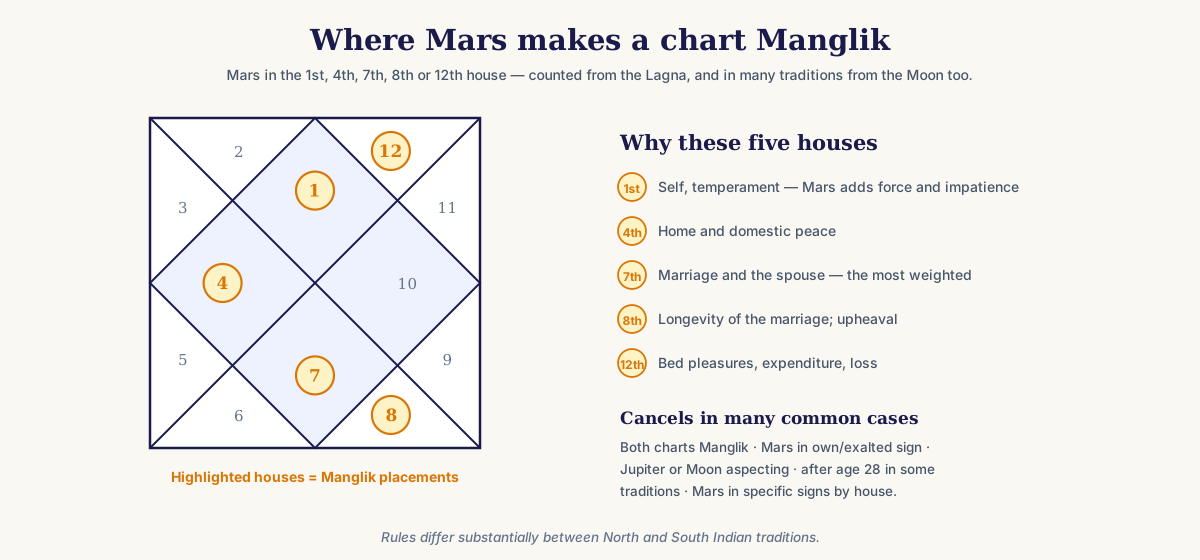
In one paragraph
Mangal Dosh — being Manglik — is a condition in a birth chart where Mars (Mangal) occupies one of a specific set of houses, traditionally the 1st, 4th, 7th, 8th or 12th. It is the single most feared term in Indian astrology, and also the most misused. This article explains exactly what the rule is, why those five houses, the long list of standard cancellations that most people are never told about, how much the rules genuinely differ between regions, and the honest position on what it does and does not mean. If you take one thing away, make it this: Manglik status is a statement about a planetary placement, not a verdict on a person or a marriage.
What Mangal Dosh actually is
Mars in Jyotisha is the graha of energy, force, courage, assertion, conflict and heat. It is not an evil planet — it is the karaka of courage and of siblings, it rules Aries and Scorpio, and it is exalted in Capricorn. A chart with strong Mars is a chart with drive.
Mangal Dosh is the doctrine that Mars, placed in certain houses relating to self, home, marriage, longevity and the marital bed, brings its heat into the domain of married life — and that this can manifest as friction, temper, dominance, delay in marriage, or difficulty.

The standard rule, and the reasoning behind each house.
The five houses, and why each is counted:
| House | Domain | Why Mars there is flagged |
|---|---|---|
| 1st | Self, body, temperament | Mars colours the personality with force and impatience |
| 4th | Home, mother, domestic peace | Heat brought into the household |
| 7th | Marriage and the spouse | The most directly weighted of the five |
| 8th | Longevity, upheaval, in-laws | Bears on the endurance of the marriage |
| 12th | Bed, expenditure, seclusion | Bears on intimacy and private life |
The part almost nobody explains: from where?
Here is the detail that causes most of the confusion and most of the false positives.
The five houses have to be counted from a reference point, and traditions disagree about which one:
- From the Lagna (Ascendant) — the most common and the baseline in most of India
- From the Chandra Lagna (Moon) — widely used in addition, and standard in much of North India
- From Venus — used in a number of traditions, since Venus is the karaka of marriage
A chart can be Manglik from one reference and clean from another. This is the single biggest reason two astrologers give you two different answers, and neither is being dishonest.
Regional variation goes further still:
- Some South Indian traditions include the 2nd house (family and speech) in the set
- Some traditions exclude the 1st
- Some count Manglik only when Mars is in specific signs within those houses
- Some grade it as Anshik (partial) versus Purna (full) Manglik
Kaalveda's free Kundli applies the standard rule — Mars in the 1st, 4th, 7th, 8th or 12th, checked from both Lagna and Moon — and tells you which reference triggered it, so you can see the reasoning rather than just a label.
The cancellations — *Manglik Dosha Bhanga*
This is the section most commercial astrology sites leave out, and it is the most important one on the page. The classical literature is full of cancellation conditions (bhanga), and once you apply them, a very large share of nominal Manglik charts are not effectively Manglik at all.
Commonly accepted cancellations include:
Both partners are Manglik. The most widely accepted of all. Two Manglik charts are traditionally considered to neutralise each other, and the match proceeds normally.
Mars is in its own sign or exalted. Mars in Aries or Scorpio (own signs) or Capricorn (exaltation) is strong and well-placed; the dosha is considered substantially reduced or cancelled.
Mars is aspected by or conjunct Jupiter or the Moon. Benefic influence tempers it.
Mars is in the sign of a benefic, or with a strong benefic.
Mars sits in specific signs by house — a long list in the classical texts, for example Mars in Cancer or Leo in the 4th, or in Sagittarius or Pisces in the 12th.
Saturn aspects the Mars in some traditions.
Age. Several traditions hold the dosha weakens substantially after roughly 28 years.
Mars is combust or retrograde — treated as diminished in some schools.
Any competent practitioner checks every one of these before applying the label. A reading that announces "you are Manglik" without walking through the cancellations is incomplete work.
What the evidence actually supports
An honest article has to say this plainly, and saying it does not require dismissing the tradition.
Mangal Dosh is not Vedic. It does not appear in the Vedanga Jyotisha, which is calendrical. It is not in the Hellenistic material that brought horoscopy to India. Its systematic treatment appears in late-medieval and early-modern texts — the same literature that produced the 36-point Ashtakoota scorecard, around the fifteenth to seventeenth centuries. The doctrine is roughly four to six hundred years old, not four thousand.
The rules are not standardised. As above, the reference point, the house set, and the cancellation list all vary by region and lineage. A doctrine with this much internal disagreement should be held with corresponding humility.
There is no evidence it predicts marital outcomes. No controlled study has found a relationship between Manglik status and divorce, widowhood or marital difficulty. The claim has not been demonstrated.
And it does measurable harm. This is the part worth being blunt about. Manglik status is used in India to break engagements, to justify dowry pressure, to distress young women in particular, and — in its ugliest expression — to require kumbh vivah, a symbolic marriage to a tree, pot or idol before the real one. Families have been talked into expensive "remedies" on the strength of a label that half the country's astrologers would compute differently.
So how should you treat it?
Not as a curse, and not as nonsense either. As one placement among dozens in a chart — and a placement whose classical treatment comes with an extensive built-in list of reasons it may not apply.
A reasonable position, and the one we would defend:
Mars in the 7th house says something real about how a person brings energy, assertion and heat into partnership. That is worth knowing, discussing and working with. It does not predict a failed marriage, it is not a defect in a human being, and it is not a reason to end a relationship between two people who want to be together.
If you have been told you are Manglik, the useful questions are:
- From which reference — Lagna, Moon, or Venus? Is it all three, or just one?
- In which sign is Mars? Own sign, exalted, debilitated?
- Which cancellations apply? Go through the list above one by one.
- What is the rest of the 7th house doing — its lord, Venus, Jupiter, the 2nd and 8th houses?
- What is actually being recommended, and what does it cost?
If the answer to question 5 escalates in price the more you push back, you are not talking to an astrologer.
Where to start
- Generate a **free Janam Kundli** — it shows Mars's house and sign, checked from both Lagna and Moon
- Run a **Gun Milan match** to see how Mangal Dosh sits alongside the eight kutas
- Find your core placements with the **Lagna, Rashi & Nakshatra calculator**
- For a full written analysis of Mars and the 7th house in your chart, see the **premium Kundli report**
Related reading: **How Kundli Matching / Gun Milan Works** · **What Is Janam Kundli or Janam Patri?** · **What Is a Horoscope and What Are the Zodiac Signs?** · **What Is Astrology — and Who Gave It to the World?**
Mars is the planet of courage. It is worth remembering that when someone tries to sell you fear about it.
Was this article helpful?
Your feedback helps us improve our content
How Kundli Matching / Gun Milan Works
Which Gemstone Should You Wear for Your Zodiac Sign?
Related Posts

Dashakoota: How South Indian Matching Differs
Much of South India matches horoscopes with Dashakoota, not the 36-point Ashtakoota. This guide sets out all ten kutas, the overlaps, Rajju and Vedha, and why two traditions can rate the same couple differently.

Astrological Causes of Delay in Marriage
The classical indicators of late marriage - Saturn on the 7th, an afflicted Venus, a 7th lord in a dusthana - and why the dasha sequence usually matters more than any affliction. Plus how to avoid being sold expensive remedies for a wait.

Love Marriage or Arranged? What the Chart Shows
The 5th-7th house link is the classical love-marriage signature, and a clean 7th with Jupiter or family houses suggests arranged. Here is what those indicators honestly mean - and what they cannot decide.