What Is Panchang and the Panchang Calendar?
By Kaalveda Research Team
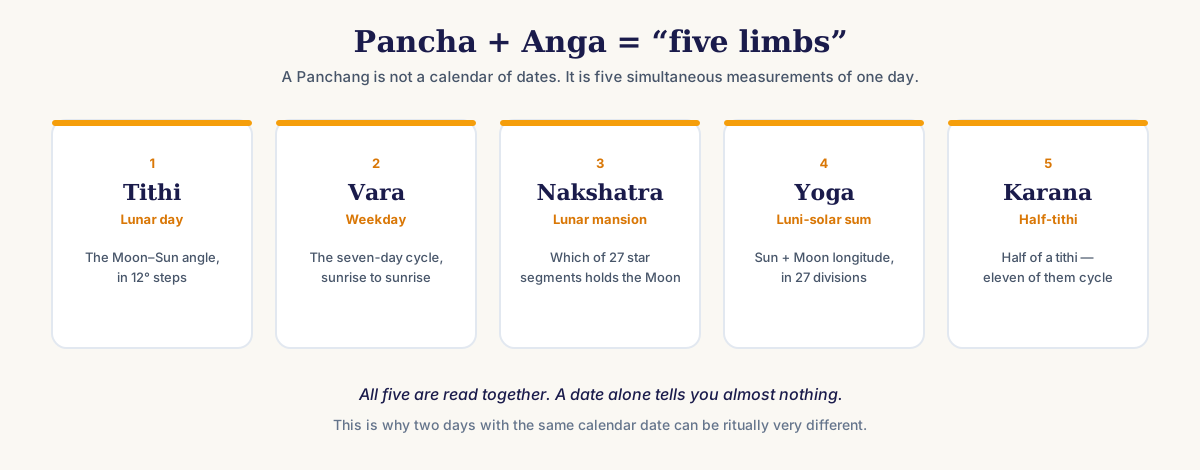
In one paragraph
A Panchang (पंचांग) is the Hindu almanac — but calling it a "calendar" undersells it badly. A Western calendar answers one question: what is today's date? A Panchang answers a different and much harder one: what is the actual quality of this particular day, measured against the real positions of the Sun and Moon? The name says it exactly — pancha (five) + anga (limbs). Five separate astronomical measurements, computed fresh for every day and for every location, which together describe the day's character. It is the instrument behind every muhurat, every festival date, and every "is today auspicious?" question asked in India.
Five limbs, not one date

A Panchang is five simultaneous measurements of one day, not a single label.
1. Tithi (तिथि) — the lunar day. The angular distance between Moon and Sun, divided into 12° steps. A full lunar month contains 30 tithis, fifteen in the waxing fortnight (Shukla Paksha) and fifteen in the waning (Krishna Paksha). Crucially, a tithi is not 24 hours long — because the Moon's speed varies, a tithi can run anywhere from roughly 19 to 26 hours. This is why festivals appear to "move" and why a tithi can occasionally be skipped or repeated.
2. Vara (वार) — the weekday. The familiar seven-day cycle, each day ruled by a graha: Ravivara (Sun), Somavara (Moon), Mangalavara (Mars), Budhavara (Mercury), Guruvara (Jupiter), Shukravara (Venus), Shanivara (Saturn). Note that in the Hindu reckoning, the day runs sunrise to sunrise, not midnight to midnight.
3. Nakshatra (नक्षत्र) — the lunar mansion. Which of the 27 star-segments the Moon currently occupies. Each spans 13°20′. This limb drives more of practical Hindu timekeeping than any other — see What Is Nakshatra and Choghadiya for the full treatment.
4. Yoga (योग) — the luni-solar sum. The combined longitude of Sun and Moon, divided into 27 divisions. Not to be confused with either the yoga of practice or the planetary yogas of a birth chart — this is a distinct daily quantity with its own 27 names, from Vishkambha through Vaidhriti.
5. Karana (करण) — the half-tithi. Each tithi splits into two karanas, giving 11 karanas that cycle through the month. Used mainly in finer muhurta work.
Read together, these five say something a date alone cannot: this day, in this place, has this character.
The single most misunderstood fact
Here is the thing that surprises almost everyone the first time they encounter it:
A Panchang is location-specific. The Panchang for Mumbai on a given day is genuinely different from the Panchang for Delhi on the same day.
The reason is that the whole system is anchored to local sunrise. Since the Hindu day begins at sunrise, and sunrise happens at different clock times in different places, the tithi and nakshatra in force at sunrise can differ between two cities on the same calendar date — which in turn can shift a festival by a day between regions.
This is not a flaw or an inconsistency. It is the system working correctly. It is also why a printed almanac from another state can be wrong for you, and why any serious Panchang must be computed for your coordinates. Ours is — check **today's Panchang** and it resolves to your location.
What else a Panchang carries
Beyond the five limbs, a working Panchang lists the timings that people actually plan around.
| Element | What it is |
|---|---|
| Sunrise / Sunset | The anchors for everything else |
| Moonrise / Moonset | Relevant to many vratas and rituals |
| Rahu Kaal | An inauspicious ~90-minute window each day; commonly avoided for new beginnings |
| Yamaganda | A second inauspicious window |
| Gulika Kaal | A third, ruled by Saturn's offspring Gulika |
| Abhijit Muhurat | A brief highly auspicious window around local noon |
| Brahma Muhurat | The pre-dawn window, traditionally best for study and meditation |
| Choghadiya | The eightfold division of daylight — see below |
| Paksha | Waxing (Shukla) or waning (Krishna) fortnight |
| Masa / Samvat | Lunar month and the year in the Vikram or Shaka era |
Rahu Kaal deserves a note because it is the most widely used and the most widely misapplied. It is one-eighth of the daylight period, and which eighth depends on the weekday. It is traditionally avoided for beginnings — signing, launching, travelling, buying. It is not a prohibition on existing, and it does not apply to work already underway.
Solar, lunar, and why Indian festivals move
India runs a luni-solar calendar, and understanding that single fact explains most of the apparent chaos in festival dates.
A lunar month — twelve of them — comes to about 354 days. A solar year is about 365¼. The gap is roughly 11 days a year, and if left alone the lunar calendar would drift right through the seasons, so that Holi eventually landed in winter.
The correction is an extra month, the Adhika Masa (also called Purushottama Masa), inserted roughly every 32½ months. This keeps the lunar months locked to the seasons over the long run, while allowing individual festival dates to shift by a couple of weeks against the Gregorian calendar year to year.
Two further wrinkles worth knowing:
- Amanta vs Purnimanta. In Gujarat, Maharashtra and most of South India the lunar month ends at the new moon (amanta); in most of North India it ends at the full moon (purnimanta). The same day can therefore carry two different month names.
- Solar-reckoned festivals. A few — Makar Sankranti most notably — track the Sun's entry into a sidereal sign rather than a lunar phase, which is why Sankranti sits on roughly the same Gregorian date each year while Diwali does not.
You can see how this plays out across the year on our **festival calendar**.
What a Panchang is used for
Muhurat — choosing a time. The dominant practical use. Weddings, house-warmings (griha pravesh), business launches, vehicle purchases, naming ceremonies and travel are all traditionally scheduled against Panchang conditions rather than convenience. A muhurat is chosen by finding a window where the tithi, nakshatra, yoga, karana and weekday are mutually favourable and which avoids Rahu Kaal and the other inauspicious slots.
Vrata and fasting. Ekadashi, Pradosh, Sankashti Chaturthi and dozens of other observances are defined by tithi, not by date — so they must be looked up each month.
Festival determination. Every major Hindu festival is fixed by a Panchang condition. Diwali is the Amavasya of Kartik; Janmashtami is Krishna Paksha Ashtami of Bhadrapada.
Daily orientation. For many households the Panchang is simply consulted the way one checks the weather — what is today's tithi and nakshatra, and is there anything to avoid?
Panchang and your birth chart
The connection people usually miss: your Janam Kundli is a Panchang, frozen.
The Panchang describes the sky today. Your kundli describes the sky at your birth. They are the same five limbs, measured at different moments — which is why your birth Panchang details (janma tithi, janma nakshatra, birth yoga) appear at the top of any properly prepared Janam Patri.
It is also how transit prediction works. Comparing today's Panchang against your birth chart is precisely what a gochara reading does — and your janma nakshatra is the anchor for the Vimshottari dasha that times the whole life.
Where to start
- Open **today's Panchang** — computed live for your location, with all five limbs, Rahu Kaal and the muhurat windows
- Check the **Choghadiya** for the current auspicious and inauspicious slots
- Look up **today's nakshatra** and what it governs
- See the year's **festival dates**
- Find your birth Panchang inside your **free Janam Kundli**
Further reading: **What Is Nakshatra and Choghadiya — and How Are They Used?** goes deeper on the two limbs that do the most practical work, and **What Is a Horoscope and What Are the Zodiac Signs?** covers the zodiac the Panchang measures against.
The short version: a date tells you when. A Panchang tells you what kind of when.
Was this article helpful?
Your feedback helps us improve our content
Dhanyog Bracelet and Dhana Yoga: What Wealth Yogas Actually Are
What Is Nakshatra and Choghadiya — and How Are They Used?
Related Posts

Tithi Explained: The Thirty Lunar Days
A tithi is the time the Moon needs to gain 12 degrees on the Sun, which is why it is never exactly 24 hours. Here is why Hindu dates skip and repeat, all thirty tithis, and the five tithi groups.

Griha Pravesh Muhurat: Timing a House Warming
Vedic tradition names three kinds of house entry, each with its own rules. This guide covers the tithi, nakshatra, weekday and lagna a griha pravesh muhurat is chosen on, the months avoided, and how to handle a possession date that will not move.

How to Choose a Wedding Muhurat
A step-by-step method for choosing a vivah muhurat - tithi, nakshatra, weekday, yoga, karana and lagna - plus the months ruled out entirely and why the Indian wedding season falls where it does.