Foundations
What astrology is, where it came from, and how it actually works.

How to Choose an Astrologer (and the Red Flags)
What a good reading actually looks like, the questions to ask before you book, and the red flags that mark a predatory practitioner - fear-selling, escalating remedies and guaranteed outcomes.

Karma, Free Will and Fate in Jyotisha
The birth chart is traditionally read as a map of prarabdha - the portion of karma already in motion - not of the whole. What Jyotisha actually says about fate, effort and the space between them.

What Are Divisional Charts (Vargas)?
A varga is a magnifying glass on one domain of life. What divisional charts are, why the navamsa carries so much weight, and the birth-time accuracy the finer ones genuinely demand.

What Is a Dasha, and How Does Astrological Timing Work
A chart shows potential; a dasha shows when it activates. How Vimshottari dasha works, why it is computed from the Moon nakshatra, and how to read a period properly.

The Twelve Bhavas: A Complete Introduction
Signs describe how; houses describe where in life. A complete introduction to the twelve bhavas, the kendra, trikona, dusthana and upachaya groupings, and the purushartha structure beneath them.

What Is Ayanamsha, and Why Vedic Astrology Is Sidereal
Ayanamsha is the angular gap between the sidereal and tropical zodiacs, currently about 24 degrees. It is the most important technical idea in Jyotisha, and the reason two kundali tools can disagree.

Vedic vs Western Astrology: What Actually Differs
Two different zodiacs, two different anchors, two different theories of timing. A fair, precise comparison of Vedic and Western astrology - what actually differs, and why neither is demonstrably more accurate.

The Nine Grahas: A Complete Introduction
Graha means to seize, not planet - which is why Rahu and Ketu belong even though they are not physical bodies. A complete introduction to the nine grahas, their rulerships, dignities and significations.

How Time Shapes Your Zodiac Sign and Your Chart
Astrology is a time-keeping system first. The Sun takes about 30 days to cross a sign, the Moon about 2.25 days, and the Ascendant about 2 hours - which is why a few minutes of birth time can change an entire chart.
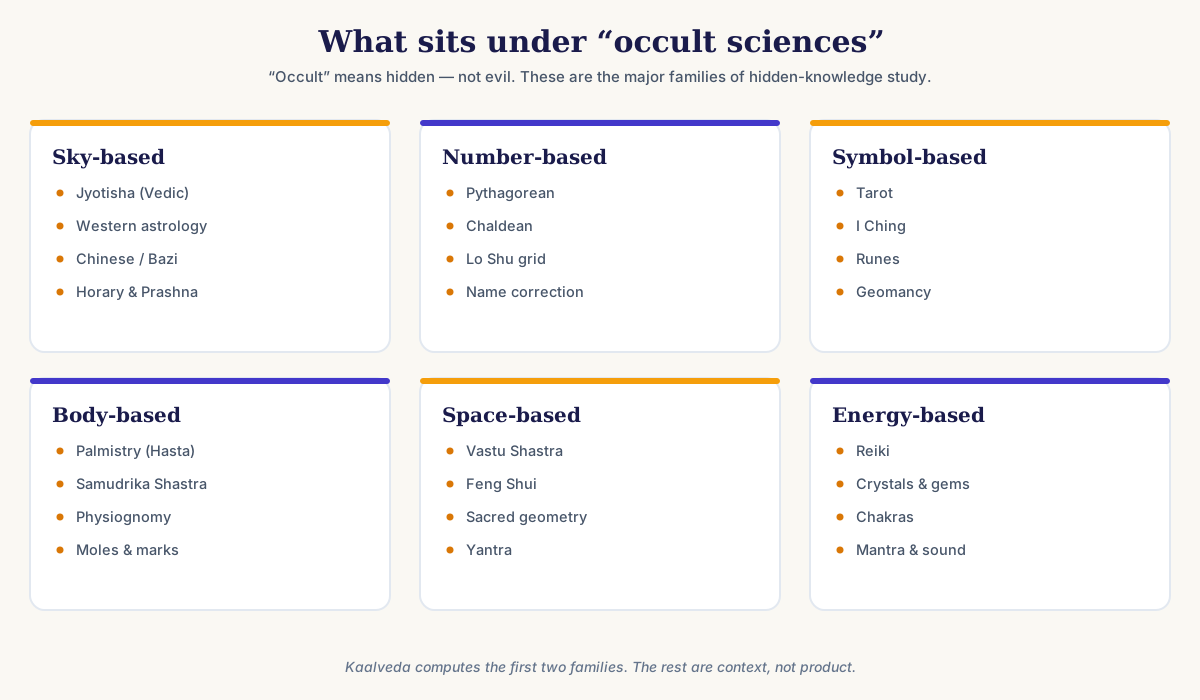
What Are the Occult Sciences, and What Falls Under Them?
Occult means hidden, not evil. Here are the six families of hidden-knowledge study — sky, number, symbol, body, space and energy — what each actually claims, and an honest account of which have evidence behind them and which are traditions of practice.

Free Astrology Chat: How to Talk to an Astrologer Online
What online astrology chat is genuinely good for: what to prepare before you start, which questions get useful answers and which do not, how AI astrologer chat differs from a human consultation, and the red flags of predatory astrology services.

Astrology Through Date of Birth: What a Birth Date Alone Can Tell You
Most people do not know their exact birth time. Here is exactly how much astrology is still available to you: what a date alone gives reliably, what becomes approximate, what is genuinely unavailable, and how to work honestly with an incomplete chart.