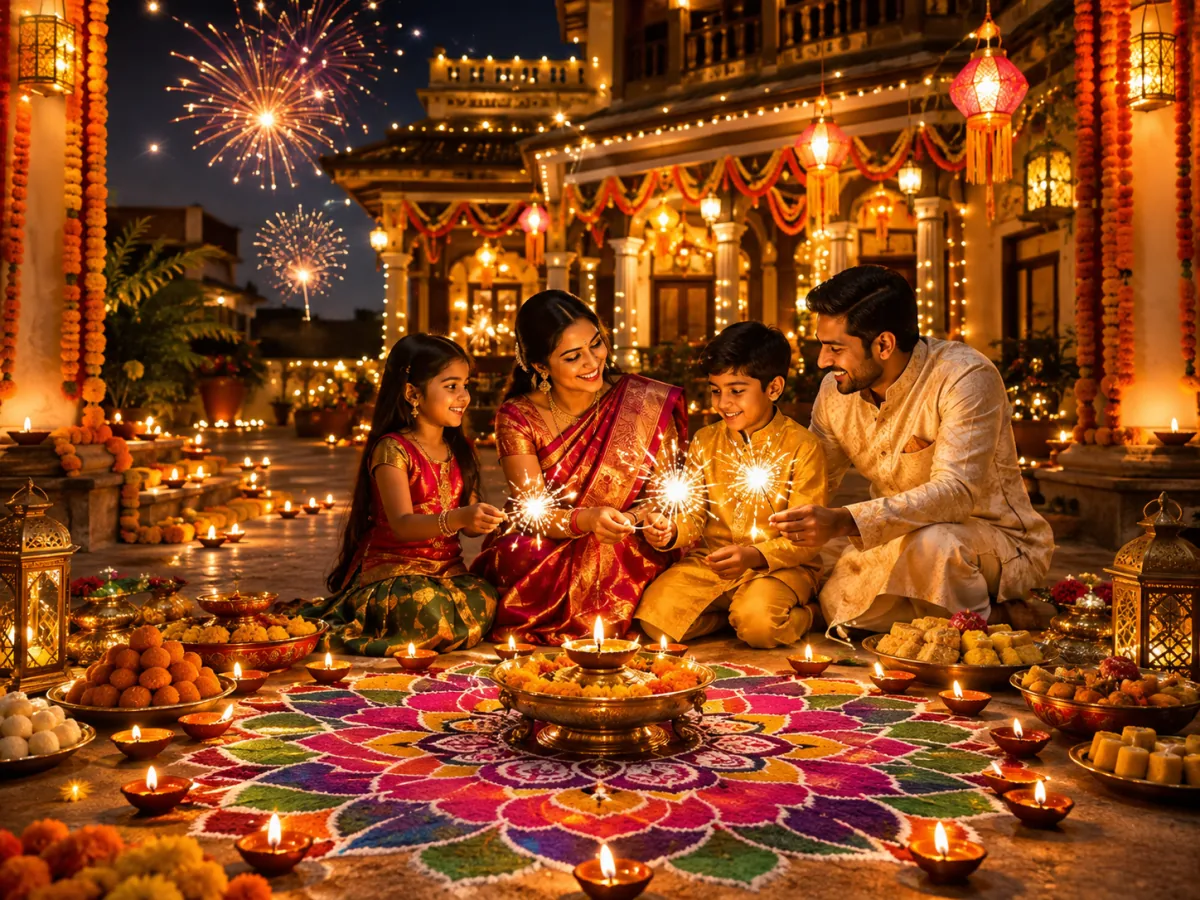
About Diwali
Diwali marks the new-moon night of Kartik month — the darkest night of the lunar cycle illuminated by millions of lamps. It celebrates Lakshmi, goddess of prosperity, alongside Ganesha, remover of obstacles. The five-day festival begins with Dhanteras and culminates with Bhai Dooj.
Significance
Diwali marks the spiritual victory of light over darkness, knowledge over ignorance, and good over evil. It is the biggest and most widely celebrated festival across the Indian subcontinent and among the global Indian diaspora.
History & story
The lighting of lamps commemorates several intertwined legends — Rama's homecoming to Ayodhya after 14 years of exile and his victory over Ravana, Krishna's defeat of the demon Narakasura, and the emergence of Lakshmi from the churning of the cosmic ocean (Samudra Manthan).
Muhurat (2025)
Lakshmi puja muhurat is traditionally during pradosh kaal (evening twilight) on amavasya tithi. Choose the auspicious window based on your city's sunset.
Rituals & observances
- ◆Lamp lighting
- ◆Lakshmi puja
- ◆Rangoli
- ◆Sweets and gifts
- ◆Fireworks
Regional variations
In North India, celebrates Rama's return to Ayodhya. In Bengal, Kali Puja same night. In South India (Tamil Nadu), Naraka Chaturdashi the day before is the main observance.
Diwali — every year
The date shifts each year on the Gregorian calendar because it follows the Hindu lunar-solar cycle.