About Dussehra
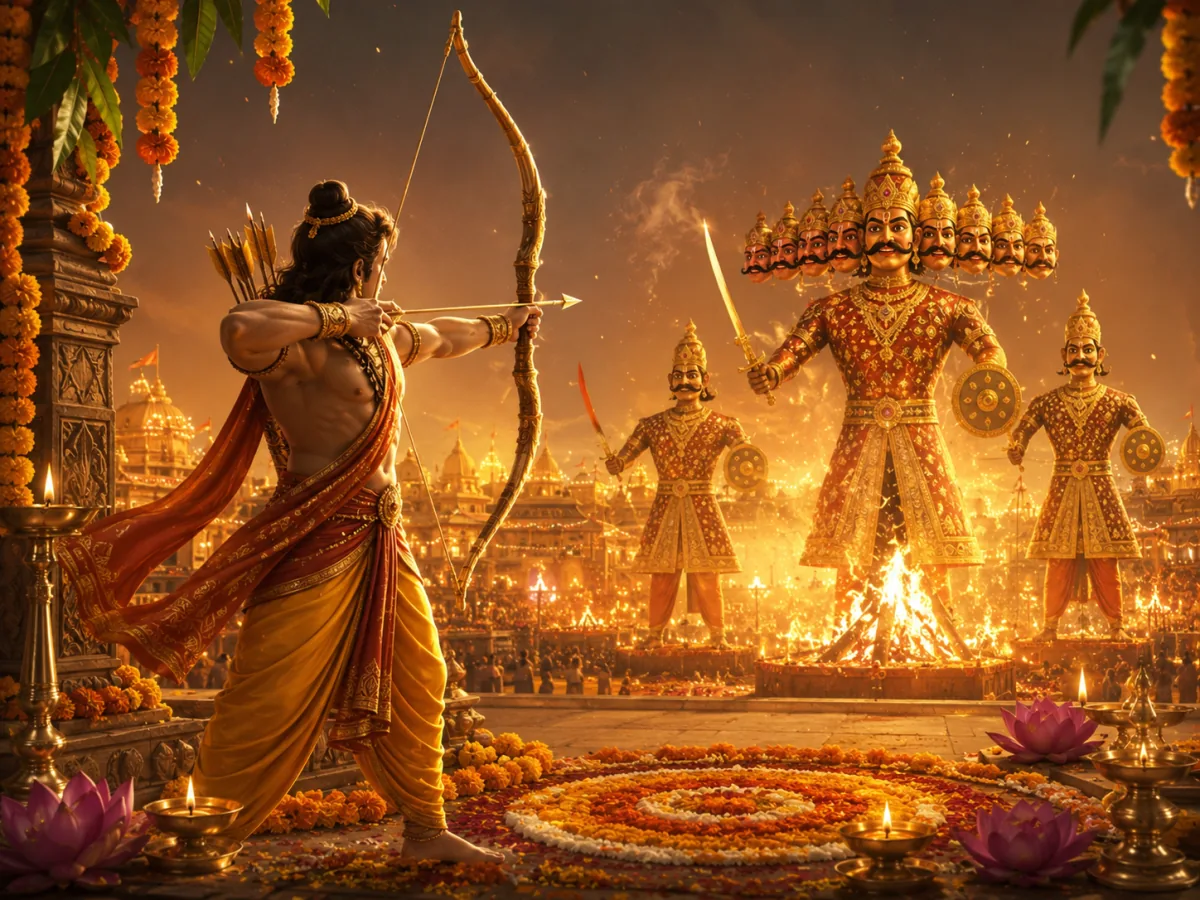
Dussehra falls on Ashwin Shukla Dashami, immediately after the nine nights of Navratri. It commemorates two intertwined victories of good over evil — Rama's defeat of the ten-headed demon king Ravana after rescuing Sita, and Durga's slaying of the buffalo demon Mahishasura. Effigies of Ravana, his brother Kumbhakarna, and son Meghnad are burned in dramatic public Ravana Dahan ceremonies across North India.
Significance
Dussehra distills the year's central moral lesson of Hindu festival life — dharma (righteousness) ultimately prevails over adharma — into a single, dramatic, publicly staged day.
History & story
The Ramlila tradition of dramatizing the Ramayana in the days leading up to Dussehra was popularized in North India from the 16th century onward, partly through Tulsidas's vernacular Ramcharitmanas, making the Rama story accessible to the masses.
Muhurat (2026)
Vijay Muhurat — the auspicious window shortly after midday (aparahna kaal) — is traditionally considered the most powerful time to begin new ventures, believed to be the exact hour Rama began his march against Ravana.
Rituals & observances
- ◆Ravana Dahan (effigy burning)
- ◆Ramlila performances
- ◆Shami tree worship
- ◆Ayudha Puja (weapon/tool worship)
- ◆Vidyarambh (starting a child's education)
Regional variations
North India centers on Ramlila plays and massive Ravana Dahan events (Delhi's Ramlila Maidan is iconic). Karnataka's Mysuru Dasara is a royal procession tradition. Bengal marks the day as Vijaya Dashami, the close of Durga Puja, with idol immersion.
Dussehra — every year
The date shifts each year on the Gregorian calendar because it follows the Hindu lunar-solar cycle.